
SugarCRM takes a thoughtful and responsible approach to artificial intelligence, with a strong focus on delivering real business value while protecting customer data. Today, SugarCRM provides both predictive and generative AI capabilities, including predictions for Leads and Opportunities, as well as summarization and Account Intelligence across Accounts, Cases, and Opportunities. SugarCRM designs AI features to help users save time and gain deeper insights from their data, rather than adopting AI for its own sake. The AI tools require no prior experience and generate responses automatically. Grounding ensures that AI outputs are aligned with each customer’s data, terminology, and real business context. Every AI-generated response is moderated to improve accuracy and prevent harmful or misleading content. Looking ahead, SugarCRM’s model-agnostic AI infrastructure and emphasis on user feedback ensure continuous improvement as AI technology evolves.
Overview of Built-in AI
GenAI is embedded in SugarCRM and supports sales, service, and support teams by assisting in repetitive tasks and improving information visibility. The AI outputs are generated while keeping all decision-making and customer interactions under human control. These capabilities are part of the Sugar Intelligence Add-on and require appropriate licensing. AI features also integrate with reporting and dashboards, allowing users to include AI-generated insights alongside other key CRM metrics.
AI in Sugar Today
Currently, Sugar offers AI tools with predictive and generative capabilities.
- Leads and Opportunities modules using the predictive capability with Prediction feature. Prediction uses your data and external firmographics to deliver predictive insights for opportunities and leads.
Cases, Opportunities and Accounts modules using the generative capability with Summarization and Account Intelligence features
How SugarCRM delivers Value with AI
The AI tools require no prior experience, as responses are generated automatically without any prompting. Grounding ensures higher-quality outputs by aligning AI responses with the user’s specific data, terminology, use cases, and business context. In addition, every response generated by SugarCRM’s AI tools is subject to a final moderation step to improve accuracy and prevent harmful content.Die KI-Tools erfordern keine Vorerfahrung, da Antworten automatisch ohne Eingabe generiert werden. Grounding sorgt für qualitativ hochwertigere Ergebnisse, indem die KI-Ausgaben an die spezifischen Daten, Terminologie, Anwendungsfälle und den Geschäftskontext des Nutzers angepasst werden. Jede von SugarCRM-KI generierte Antwort unterliegt einem finalen Moderationsschritt, um die Genauigkeit zu verbessern und schädliche Inhalte zu verhindern.
Key Features
AI Summaries (GenAI)
The AI Summary dashlet provides concise overviews of records in supported modules:
Accounts
Opportunities
Cases (support tickets and service requests)
The summaries aggregate information from multiple sources, highlighting key events, recent updates, and interactions to give a complete picture of the record at a glance. Users can see trends in activities, outstanding tasks, and notable communications without manually compiling the information.
Account Intelligence
Sugar Intelligence provides deeper insights into accounts by analyzing historical trends, activities, and performance data. This allows users to spot opportunities, understand customer engagement levels, and prioritize actions based on factual record data. Insights can also be exported into dashboards or reports for broader analysis.
Once the AI Summary dashlet is added to an Account, initial information is generated when the record is first opened, with notifications sent when ready. AI intelligence regenerates automatically as new data becomes available, consuming tokens each time. Users should always verify important information, as AI-generated responses may contain inaccuracies.
What data will be analyzed?
- Leads
- Cases
- Calls
- Meetings
- Tasks
- Notes
- Opportunties
- Revenue Line Items
- Purchased Line Items
- Quotes
Emails from both the account record and related contact, opportunity, and case records. Associating e-mail records leads to more valuable generated intelligence.
Dashlet structure
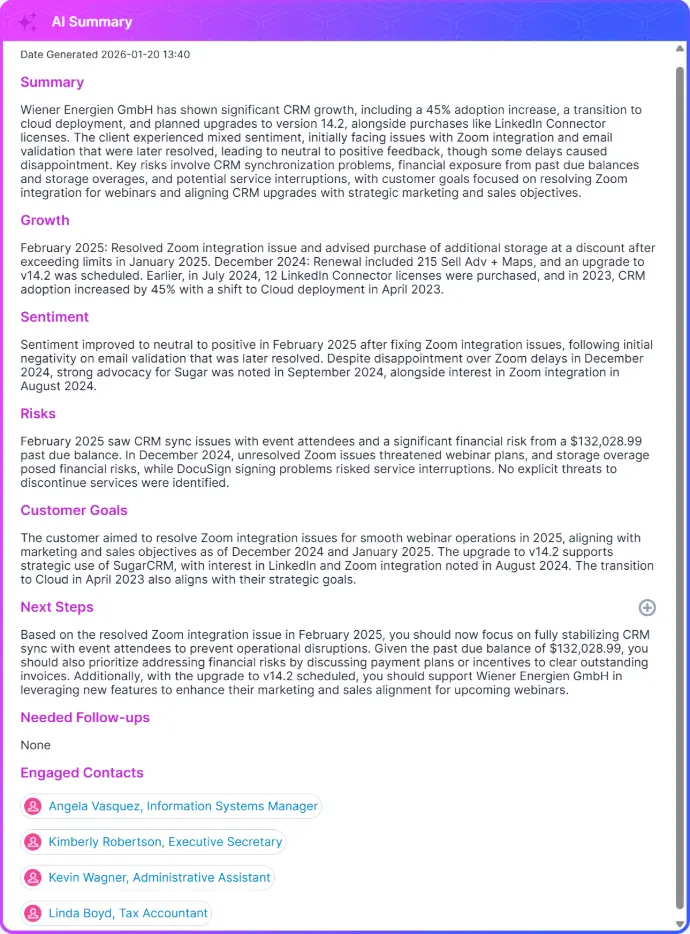
The dashlet is divided into sections to help you quickly scan the generated information. The following sections included in the dashlet:
- Summary: A concise summary of key information, communications, and interactions related to the account
- Growth: Insights into how the account has grown and potential areas of future growth
- Sentiment: The perceived sentiment of the account and the reasoning for this perception
- Risks: Identified risks that may impact the health of the account
- Customer Goals: Insight into the customer's goals with your product
- Next Steps: Suggested next steps based on account's current state and an action button for quickly creating a related email, call, meeting, note, or task with useful prefilled information
- Needed Follow-ups: Suggested follow-ups associated with related meeting, email, and call records and a direct link to the related record for quick context
Engaged Contacts: Contacts related to the account or other associated records that have engaged with the highest number of emails, calls, and meetings
Context-Aware Content Assistance
GenAI can help draft emails, case responses, or notes by referencing historical communication and related data. Outputs are generated directly from the CRM, ensuring relevance and consistency. The AI can highlight important points from previous interactions or suggest key follow-up actions.
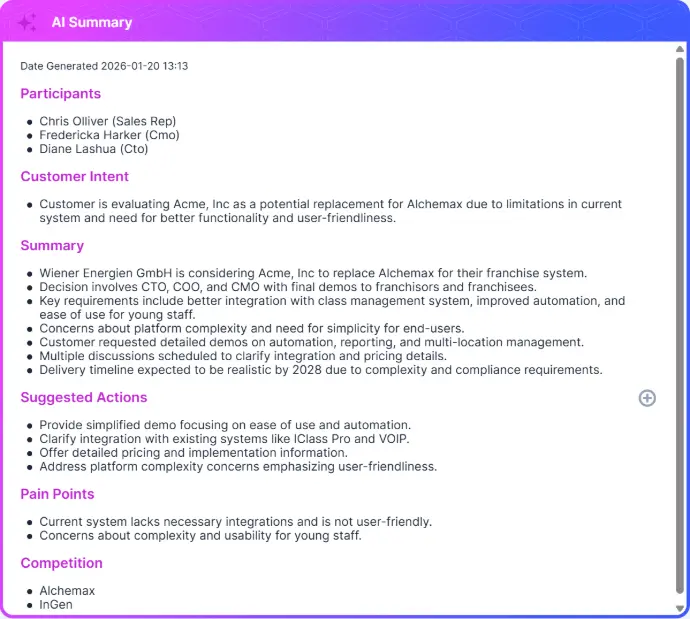
Once added to Opportunity or Case dashboards, the AI Summary dashlet generates information when a record is opened and automatically updates as new data becomes available, consuming tokens each time. Again, users should always verify important information, as AI responses may contain inaccuracies.
Analyse-Daten für Opportunities Summarization:
- Contacts
- Emails
- Calls
- Meetings
- Notes
- Tasks
- Comment Logs
Analyse-Daten für Cases Summarization:
- Emails
- Calls
- Meetings
- Notes
- Comment Logs
- Escalations
- Bugs
The summary sections on the Opportunities Dashboard
- Participants: Anyone involved with the opportunity and their perceived role
- Customer Intent: Expected outcome of the opportunity and the reasoning for this expectation
- Summary: Concise summary of important information, communications, and interactions related to the opportunity
- Suggested Actions: Suggested next actions based on the current state of the opportunity and an action button for quickly creating a related email, call, meeting, note, or task with useful prefilled information
- Pain Points: Any perceived risks to the success of the opportunity
Competition: Any competitors involved with the opportunity
The summary sections on the Cases Dashboard
- Participants: Anyone involved with the case and their perceived role
- Summary: Concise summary of important information, communications, and interactions related to the case
- Steps taken: An outline of steps taken to resolve the case
- Blockers: Any blockers to the resolution of the case
- Suggested Next Steps: Suggested next steps based on the current state of the case and an action button for quickly creating a related email, call, meeting, note, or task with useful prefilled information
Sentiment: The perceived customer sentiment and the reasoning for this perception
Prediction
Prediction in SugarCRM uses your CRM data and external firmographic information to provide predictive insights for leads and opportunities. To activate it, basic auditing must be enabled on key fields, and a sufficient number of recent lead and opportunity records must exist. Meeting these data requirements does not automatically guarantee a usable AI model. For SugarCloud instances, Account Intelligence and Summarization are activated automatically, while on-site instances require support from a Customer Success Manager. Once the data is assessed against AI models, Prediction is enabled if projected outcomes reach acceptable accuracy. If accuracy is too low, adjustments can be made to improve results. After activation, changes to Prediction fields update metadata on leads and opportunities, which may trigger related workflows. This ensures that predictive insights are integrated directly into CRM processes.
Sentiment Analysis
The AI Sentiment field displays the current sentiment generated by the AI Summary dashlet for a case record. AI identifies sentiment in communications across Accounts, Opportunities, and Cases. For instance, emails or case notes can be automatically tagged with positive, neutral, or negative sentiment, helping teams quickly identify potentially problematic interactions and respond appropriately.
Embedded Workflow Integration
All AI features are fully integrated within the SugarCRM interface, eliminating the need for external tools or separate modules. Users can access AI insights directly within record views, dashboards, or reports, reducing context switching and ensuring AI assistance fits naturally into existing workflows.
Security and Governance
SugarCRM’s AI features adhere to enterprise-grade security policies:
- Customer data remains within the system.
- AI respects access rights and data governance.
- AI processing does not use data for external model training.
Admins can configure which modules and fields are included in AI summaries.
Wanna read more about this topic?
- SugarCRM Support - AI Summarization Guide
- SugarCRM Support - AI Summarization Administration Guide
- SugarCRM Support - AI Summarization Guide
- SugarClub - Sugar Intelligence Add-on
- SugarCRM Support
Conclusion
SugarCRM’s built-in AI capabilities, including GenAI summarization, Account Intelligence, and Sentiment Analysis, provide practical functionality that enhances CRM usage. They allow teams to access structured insights, draft content efficiently, and monitor customer interactions more effectively, all within the secure CRM environment. These features support efficient workflows for Accounts, Opportunities, and Cases.